
Evidence
Does it affect work that matters?
The Kamoto Approach
We connect what people experience with how the company works—
and turn it into decisions leadership can act on.
The cost of too many priorities
They may all be right. Leadership still has to choose.
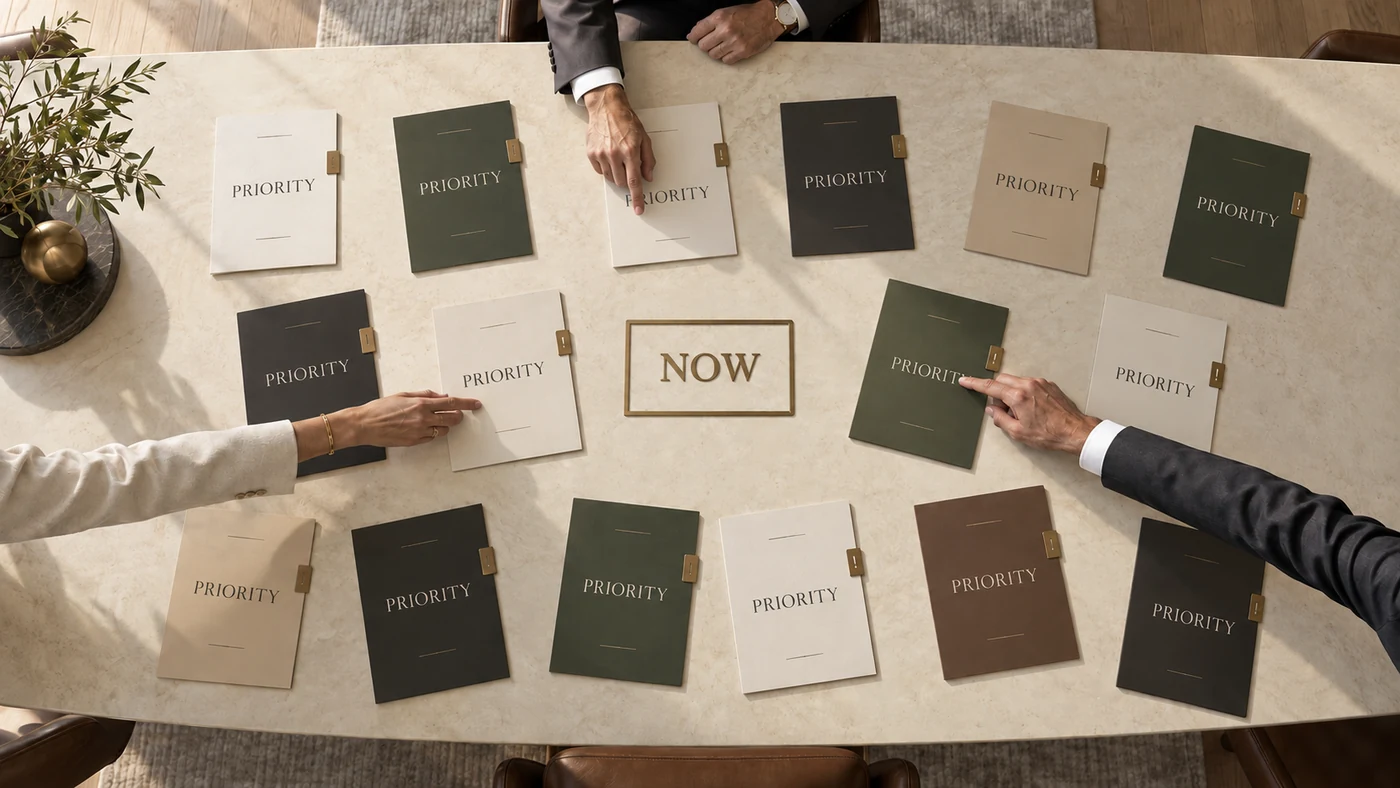
Does it affect work that matters?
Do we understand it well enough?
What happens if nothing changes?
If everything is a priority, the old problems will still be there next quarter.
01 — Align
Imagine starting every call with one question: “Am I adding value here?” If nobody can give you a clear answer, you leave.
Most people would never do it. Yet they sit through meetings nobody needs, follow processes nobody can explain and ask for approvals nobody really uses. We start by asking the same uncomfortable question about the diagnostic itself: what does leadership actually need to understand, and what will they do differently once they know?
Where does work slow down, become unnecessarily difficult or depend on somebody stepping in to rescue it?
Faster decisions? Clearer ownership? Fewer handovers? We define what useful progress would look like.
02 — Diagnose
You rewrite an email to an executive three times. You remove the background, keep the essential facts and make the decision required completely clear.
Why don’t we give our peers the same courtesy?Org charts show how the company is supposed to work. People tell us what happens when two teams disagree and somebody needs an answer by Friday.
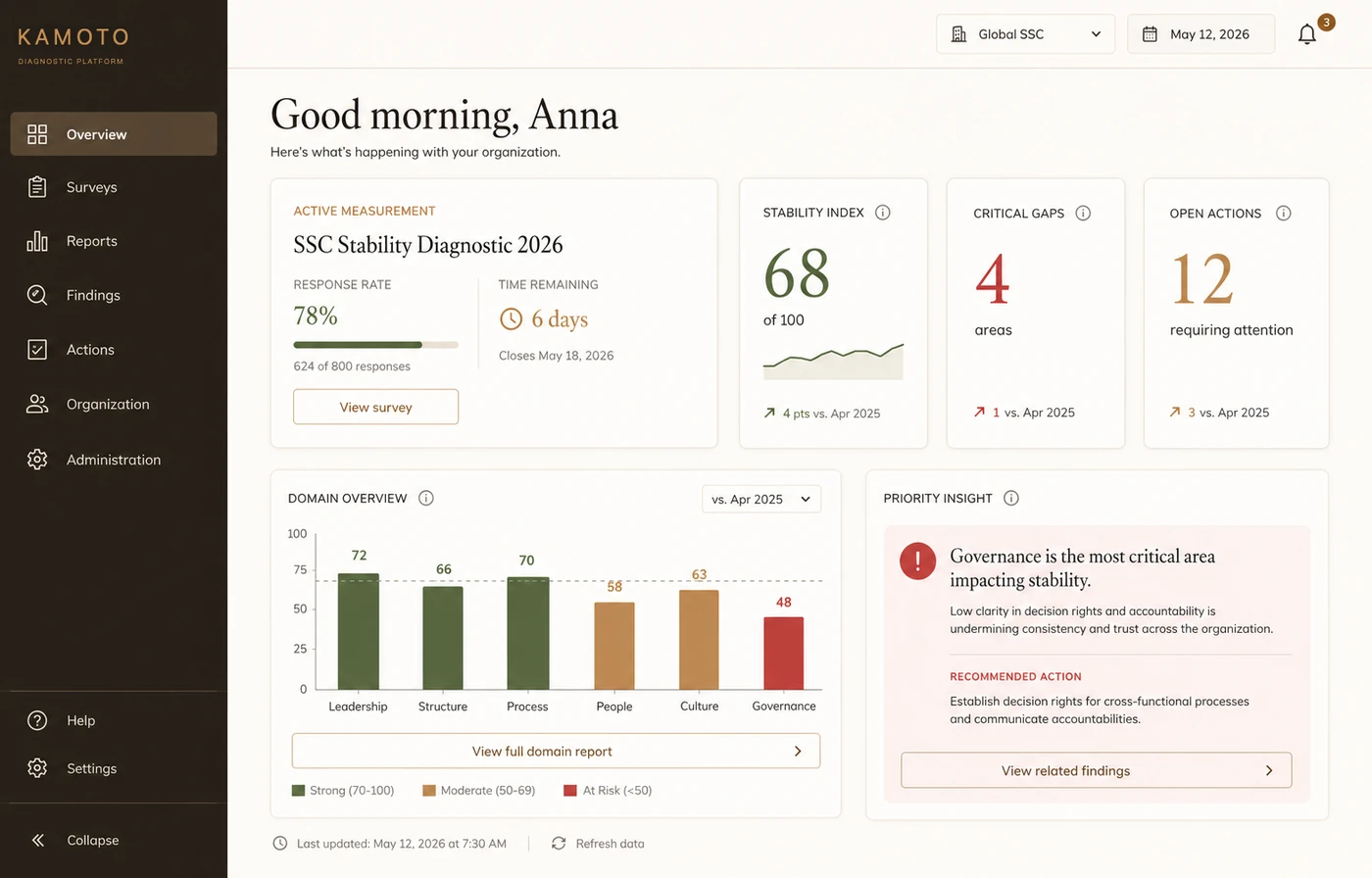
Capability, engagement and alignment.
How work flows and connects.
Quality, access and insight.
Roles, spans and accountabilities.
Behaviours, norms and decisions.
Enablers and adoption.
Short enough to complete. Detailed enough to be useful. Anonymous by design.
Leadership alignment
We have seen leaders nod in complete agreement—and leave the room with three different interpretations of what was agreed.
Presenting the findings is not enough. Leaders agree on what the evidence means, what will change and who owns it.
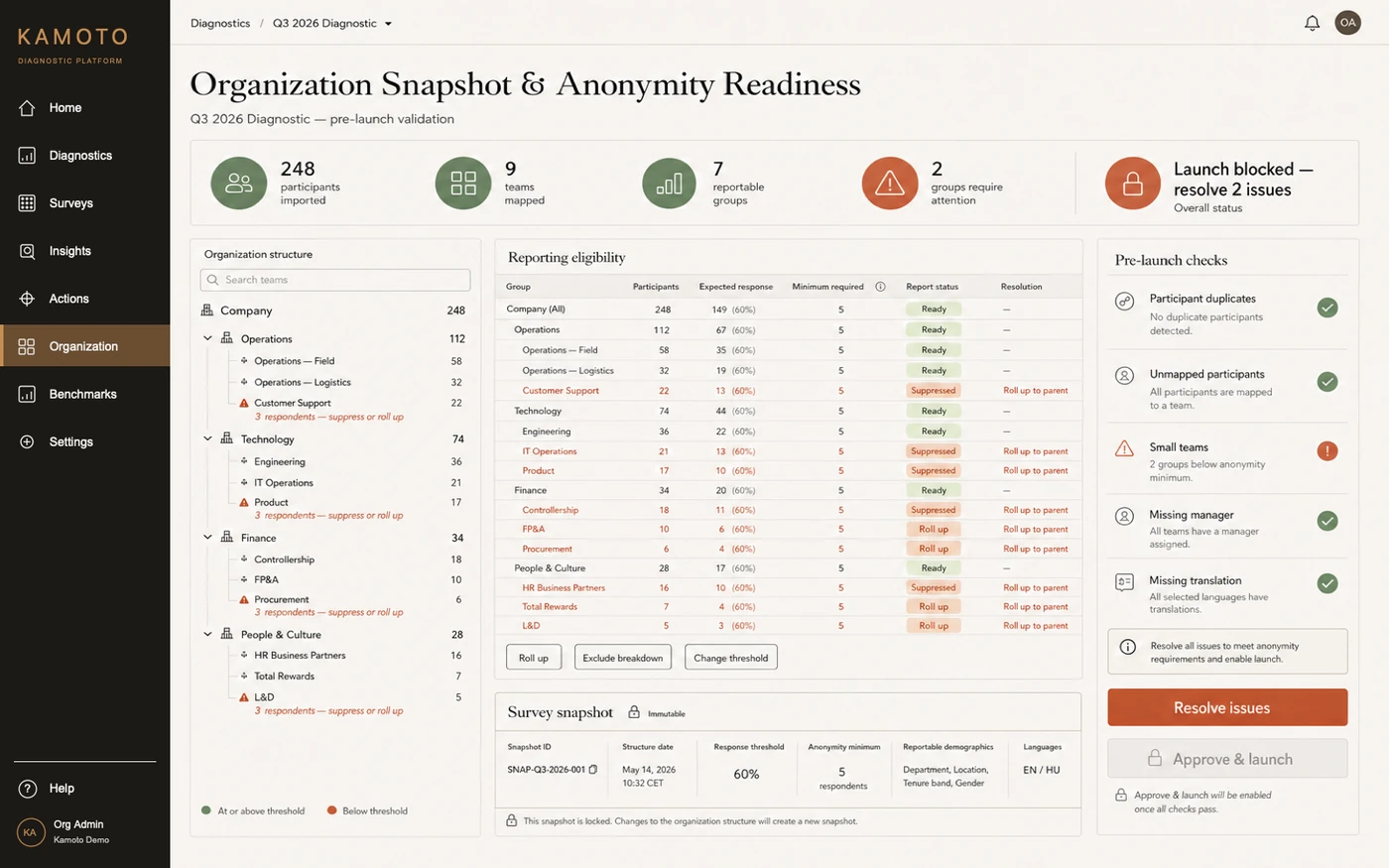
Before the diagnostic starts, leadership agrees on who should be heard, what can be compared and where anonymity must be protected.
Agree on what the evidence shows, even when views of the cause differ.
Choose the few problems that deserve leadership attention now.
Keep owners, progress and results visible after the workshop ends.
Evidence changes the conversation. Leadership decisions change the company.
03 — Understand
A leadership team tells us decisions are delegated. Ten minutes later, a manager says:
“Yes, I can decide—but I need approval first.”Both may be telling the truth. The policy says one thing. Daily experience says another. Our job is to make that gap visible without turning it into a debate about who is right.
We find recurring patterns across teams, roles and responses.
We test the pattern against real situations with the people doing the work.
We turn the evidence into a small number of choices leadership can actually make.
The tool captures the pattern. The conversation tells us what it means.
04 — Intervene
Someone suggests another weekly meeting. Everyone knows the calendar is already full. The meeting is scheduled anyway.
Three weeks later, the original problem is still there—now with minutes.We choose the smallest intervention capable of changing the cause.
Create shared direction when priorities compete.
Change habits built around escalation and rescue.
Build clearer roles, routines and handovers.
Reduce avoidable pressure on people and knowledge.
No standard package. No intervention pulled off a shelf.
05 — Prove
Everybody leaves the workshop energized. The slides are excellent. The action plan has owners, deadlines and three shades of green.
Then an ordinary Tuesday happens.That is the real test. Are decisions moving faster? Are fewer tasks bouncing back? Do managers spend less time chasing and rescuing work?
Keep the original picture.
Give the change an owner and a next step.
Ask the same questions again.
See what improved—and what did not.
No second measure, no victory speech.
The meeting nobody needs. The approval nobody can explain. The task that returns to the same person every Friday. Tell us what keeps happening.